Lung Cancer Screening for Smokers

Reviewed by: Dr. Jesús Ramón Sosa Chombo · Pulmonology · Pulmonary Oncology · Specialty license 14129039
Last reviewed:
Early detection program for lung cancer using low-dose computed tomography.
Description
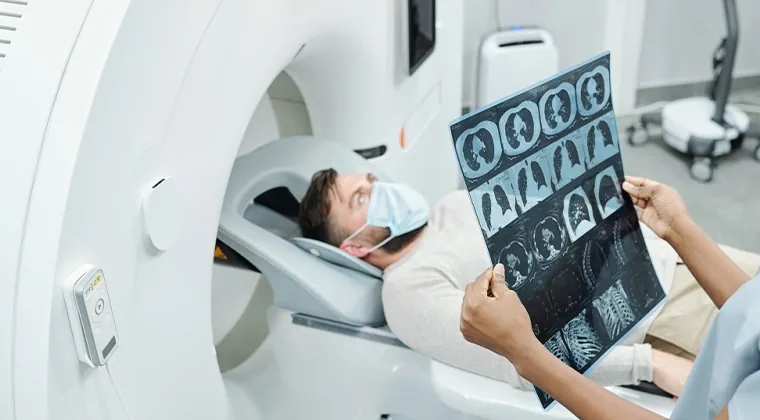
Lung cancer screening for smokers is an early detection program designed to find lung cancer in its initial stages, when it is more treatable. It is performed with an annual low-dose computed tomography (LDCT) scan of the chest in people at high risk. According to the US Preventive Services Task Force (USPSTF, 2021), it is indicated for adults aged 50 to 80 who currently smoke or quit less than 15 years ago and who have a smoking history of 20 pack-years or more (for example, 20 cigarettes a day for 20 years). In the NLST study, low-dose CT reduced lung cancer mortality by 20% compared with a chest X-ray; in the NELSON study, it reduced lung cancer mortality by 24% in men at 10 years compared with no screening.
Benefits
- Early detection of lung cancer
- Detection in early stages, when there are more treatment options
- Reduction in lung cancer mortality
- Peace of mind for high-risk patients
- Identification of other lung conditions
Is it painful?
No, it is a non-invasive test and is not painful.
What is it for?
To find lung cancer at its earliest stages, before symptoms appear, which allows timely treatment and raises survival rates.
Myths
- Screening is not necessary if there are no symptoms - False: its value lies in detecting cancer before symptoms appear
- The radiation from the test is dangerous - False: a low-dose CT emits about 1.5 mSv, much less than a conventional chest CT; for people who meet the criteria, the benefit outweighs the risk
- If screening finds a nodule, it is cancer - False: most nodules are benign; some require a follow-up CT scan to confirm this
Process
- Evaluation of eligibility criteria (age, smoking history, and time since quitting)
- Patient preparation
- Low-dose computed tomography scan
- Image analysis by a specialized radiologist
- Interpretation of results
- Follow-up based on findings
Types
- Initial screening: first evaluation of an eligible patient
- Follow-up screening: scheduled annual check-ups
Does it require a hospital stay?
Outpatient
How long does it take?
Image acquisition takes only a few minutes
Does it require anesthesia?
No anesthesia required
How long is the recovery?
No recovery time is needed; you can return to your normal activities right away
What care do I need afterward?
- Wait for instructions on when and how the results will be given to you
- If suspicious findings appear, follow the recommendations for additional tests
- Continue with the annual screening program
- Continue or start a smoking cessation program
Frequently asked questions
Do I need any preparation?
No fasting or contrast medium is required. Bring your CT scan (disc and report) and your earlier scans for comparison.
When will I get my results?
Your pulmonologist reviews and interprets the CT scan with you during your visit.
Sources: USPSTF (2021) · NLST (2011) · NELSON (2020)
Our services
Explore our other services
If you are a current or former smoker at high risk, book an appointment at AirCare Salud Respiratoria for lung cancer screening, which looks for lesions at early stages.
Book online on Doctoralia14 services available