Spirometry (slow and forced)

Reviewed by: Dr. Juan Carlos Acosta Salazar · Pulmonology · Respiratory Physiology and Therapy · Specialty license 14126695
Last reviewed:
A test that measures how much air you can exhale from your lungs and how quickly. It is the foundation for diagnosing asthma and COPD.
Description
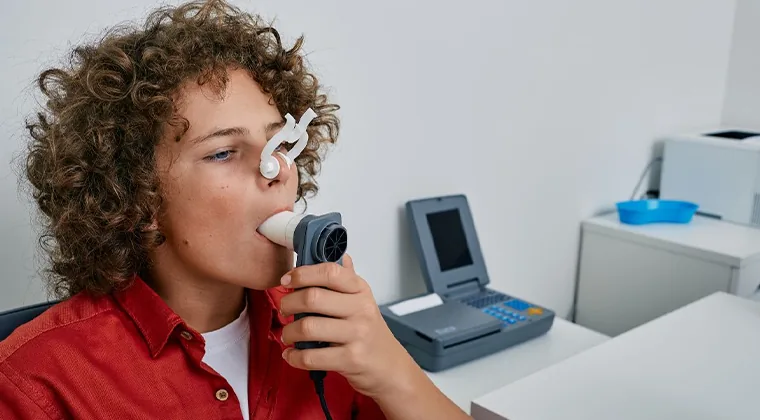
Spirometry is the most widely used lung function test: it measures how much air you can exhale from your lungs and how quickly you can do it. It is essential for diagnosing and monitoring asthma, chronic obstructive pulmonary disease (COPD), and pulmonary fibrosis, among other conditions. In forced spirometry, you fill your lungs as much as possible and exhale all the air with as much force and speed as you can; this produces the forced vital capacity (FVC), the forced expiratory volume in the first second (FEV1), and their ratio (FEV1/FVC), which show whether the airways are obstructed. When confirming asthma or COPD, the forced test is repeated about 15 minutes after inhaling a bronchodilator (spirometry with bronchodilator) to see whether the obstruction improves. In slow spirometry, you exhale calmly and completely, without forcing; it measures the slow vital capacity and inspiratory capacity, which are useful mainly in COPD, where forced exhalation can close the small airways too early, or when the forced maneuver is not possible.
Benefits
- Early and accurate diagnosis of lung diseases
- Monitoring of disease progression
- Assessment of response to treatment
- Measurement of lung capacity
- Objective monitoring of respiratory function
Is it painful?
It is not painful. It requires a maximum breathing effort, which can be tiring, but it does not cause pain.
What is it for?
To diagnose and distinguish obstructive diseases (asthma, COPD) from restrictive ones (pulmonary fibrosis), assess the impact of factors such as smoking, determine the severity of lung disease, and evaluate how well medications are working.
Myths
- Spirometry is only done once - False: for monitoring chronic diseases, it is performed periodically
Process
- Patient preparation and explanation of the procedure
- Placement of a nose clip and mouthpiece
- Performance of specific breathing maneuvers
- Slow spirometry: after filling your lungs, exhale all the air calmly and completely
- Forced spirometry: after filling your lungs, exhale the air as hard and as fast as possible
- If indicated: inhalation of a bronchodilator and a repeat forced spirometry 15 minutes later
- Immediate analysis of results
Types
- Slow spirometry: measures slow vital capacity and inspiratory capacity, without a forced maneuver
- Forced spirometry: measures FVC, FEV1, and their ratio (FEV1/FVC) to detect obstruction
- Spirometry with bronchodilator: repeats the forced test after an inhaled medication; it is necessary to confirm COPD and supports the diagnosis of asthma
Does it require a hospital stay?
Outpatient (performed at the clinic)
How long does it take?
30 to 45 minutes, including preparation and instructions
Does it require anesthesia?
No anesthesia required
How long is the recovery?
No recovery needed
What care do I need afterward?
- There are no specific recommendations after spirometry
- Continue any existing medical treatment
- Follow your doctor's instructions based on the results
- Schedule follow-up if indicated
Frequently asked questions
What types of spirometry are there?
Three. Forced spirometry, in which you exhale all the air with as much force and speed as possible; slow spirometry, in which you exhale calmly and completely; and spirometry with bronchodilator, which repeats the forced test about 15 minutes after you inhale a medication to see whether the obstruction improves.
Do I need to prepare for anything?
Wear comfortable clothes. Do not smoke, vape, or exercise intensely in the hour before the test. If you use inhalers, your doctor will tell you whether to stop them and how many hours before.
When will I get my results?
At the same time the test is performed.
Sources: ATS/ERS (2019)
Our services
Explore our other services
If you need an evaluation of your lung function, we invite you to have a spirometry test at AirCare Salud Respiratoria.
Book online on Doctoralia14 services available